
Delivering Practical Ergonomic Skills: Workstation Risk Assessment Training with Western Region Health & Osteopathy

Recently, I had the opportunity to deliver a customised professional development session for the team at Western Region Health & Osteopathy, focused on workstation ergonomic risk assessments for allied health professionals.
This session was designed specifically for clinicians looking to expand their skillset beyond traditional clinical practice and into occupational health and workplace ergonomics—an area that continues to grow in relevance across healthcare and corporate environments.
Why Workstation Ergonomics Matters
Work-related musculoskeletal issues remain one of the leading contributors to workplace injury, often driven by poor workstation setup, prolonged static postures, and repetitive tasks
For allied health professionals, this presents both:
- A clinical challenge, and
- A significant opportunity to support patients in their real-world environments
At Corporate Work Health Australia, our approach is grounded in the principle of:
Fitting the job to the person—not the person to the job
What We Covered in the Session

This was not a generic training session. It was fully customised to the needs of the team and structured to bridge the gap between theory and real-world application.
1. Understanding Ergonomic Risk
We explored how to identify key risk factors including:
- Sustained static postures
- Suboptimal workstation layout
- Task-specific demands
- Psychosocial and behavioural contributors
Participants developed a structured way to assess risk beyond “just posture”.
2. The Workstation Assessment Framework
We walked through a practical framework aligned with how we deliver ergonomic assessments across Australia, including:
- Worker history and task analysis
- Identification of hazards and contributing factors
- Real-time workstation adjustments
- Clear, actionable recommendations
This mirrors the approach used in our workplace services, where assessments include task review, risk identification, and tailored education
3. Practical Application & Case-Based Learning

A major focus was hands-on learning:
- Real workstation setups
- Before-and-after case examples
- Group-based problem solving
This ensured participants could confidently translate knowledge into practice immediately.
4. Communication & Clinical Integration
We emphasised:
- How to communicate ergonomic advice effectively
- Integrating ergonomics into clinical care plans
- Working within workplace and WHS frameworks
This is where many clinicians unlock additional value—moving from treating symptoms to influencing the cause.
Why This Training Matters for Allied Health Professionals
For clinicians, developing skills in workstation ergonomics allows you to:
- Expand into occupational health services
- Improve patient outcomes by addressing workplace drivers of pain
- Provide evidence-informed, practical advice
- Diversify your career beyond traditional clinical roles
At CWHA, we’ve now trained over 1,800+ health professionals in ergonomics, vehicle ergonomics, and manual handling
A Customised Approach That Drives Engagement
One of the key highlights of this session was the engagement and collaboration across the team.
Rather than passive learning, the session was built around:
- Discussion
- Reflection
- Peer learning
- Practical problem-solving
This aligns with a participatory approach to ergonomics, where involving workers (or clinicians) leads to better outcomes and implementation.
Continuing Professional Development Opportunities

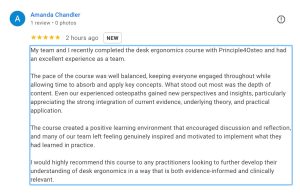
Screenshot
If you’re an allied health professional looking to build similar skills, we offer a range of professional development pathways:
🔹 Workstation Ergonomic Risk Assessment Training
Designed for clinicians wanting to confidently assess and manage office and home work environments
👉 https://corporateworkhealth.com.au/training/ergonomics/workstation/
🔹 Vehicle Ergonomics for Health Professionals
Learn how to assess and manage risks for workers who drive as part of their role
👉 https://corporateworkhealth.com.au
🔹 Online Ergonomic Training Courses
Flexible, self-paced learning with practical resources and templates
👉 https://corporateworkhealth.com.au/training/ergonomics/online/
Final Thoughts
This session with Western Region Health & Osteopathy was a great example of what happens when:
- Clinical expertise meets real-world application
- Education is practical, not theoretical
- Teams are empowered to think beyond the treatment room
The future of allied health is not just in treating injuries—but in preventing them, understanding work demands, and influencing systems.
Interested in bringing this training to your team?
We deliver customised ergonomic training and occupational health education across Australia, tailored to your team, industry, and workplace.
📩 heathwilliams@corporateworkhealth.com
🌐 www.corporateworkhealth.com.au